


TMC fourth in the world to implant new life saving heart device
By Tucson Medical Center
·
12/14/2021
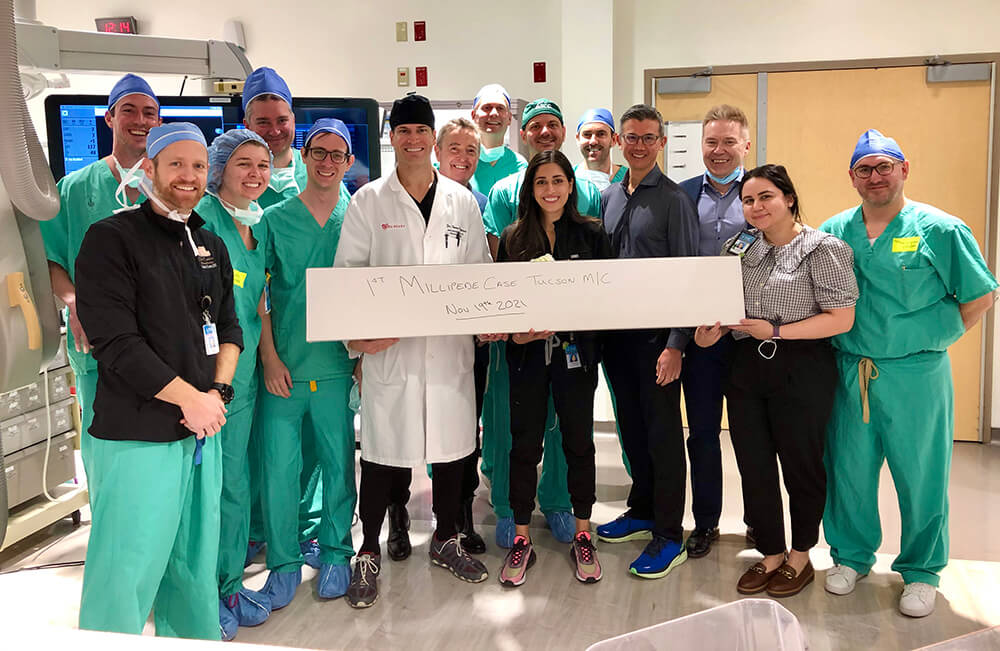
TMC fourth in the world to implant new life-saving heart device
When you focus on the patient, everything else falls into place.
This includes the privilege of being selected over larger and better-known facilities for groundbreaking research and clinical studies to save patients lives.
Last month, Tucson Medical Center became one of the very first cardiovascular centers in the world to successfully implant the Millipede device. The 84-year-old patient was suffering from mitral valve regurgitation, a condition in which the heart’s mitral valve does not close tightly – allowing blood to flow backward in the heart rather than forward. The Millipede device tightens the ring-like structure around the mitral valve itself, stopping blood from flowing backward.
A less invasive alternative to open heart surgery
This past spring, Brooks had the Watchman device implanted in his heart to treat stroke risk due to atrial fibrillation. Months later, Thomas Waggoner D.O., director of TMC’s Structural Heart and Cardiovascular Research programs, discovered Brooks also had mitral regurgitation. The only available option that was available to treat it was open-heart surgery to replace the valve.
Brooks didn’t want to undergo extensive surgery, so Dr. Waggoner told him about the Millipede study.
“I was a little nervous about it,” Brooks said. “But Boston Scientific makes it. They made the Watchman and have a good history of being an ethical company, so I went for it.”
Accessible options for patients
With Brooks interested in the study, Ariana Ehsan M.D., TMC’s first cardiovascular research fellow, got to work on learning about his medical history and making sure the Millipede study and device were the right fit for him in fixing the problem at hand and not causing any new ones.
The procedure was a success. The patient is feeling well and he is getting his strength back.
“I feel fantastic,” Brooks said. “I’m still taking it easy. I’m not trying to run any foot races or doing strenuous things, but my blood pressure and everything else is feeling very well. I’m going to be seen by TMC Cardiac Rehab to help regain my strength, so I’m eager to see what that can do for me.”
The Millipede device has not been approved by the FDA just yet. It is currently in the early feasibility study stage, meaning it is in the early stages of proving how effective of a device it is. Dr. Ehsan said, “it is rare for an institution to be selected for an early feasibility study. Centers are carefully vetted based off their patient outcomes and involvement of both clinical and research teams. A site has to show they can truly be collectively effective in providing patient care.”
“It is a true honor to be selected,” Dr. Waggoner said. “There are many traditional and established cardiovascular centers in Arizona and the greater Southwest – we are honored and humbled to be recognized among them as a leading center and chosen site for this study.”
Adding to our toolbox to help more patients
Dr. Waggoner is excited about the options clinical trials and research studies provide for patients.
“By participating in research studies and trials, we expand the therapeutic options and continue to add more tools to our toolbox to treat patients,” Dr. Waggoner said. “We are able to offer individualized medicine and health care driven by innovation. We just started our research program two years ago and we are already getting these early feasibility studies. It’s a remarkable feat. It usually takes a research program 10 years to establish itself, and then, be chosen for an early feasibility study. I am extremely proud of my team and so glad we are able to help patients like this one. We are honored and privileged to be one of the very first cardiovascular centers in the world to implant the Millipede transcatheter mitral repair system and offer our patients the most leading-edge technology for their cardiovascular care.”
For patients, participating in a study is a way to help future patients. For Brooks, everything fell into place.
“It feels good to be able to do something that can help someone else and make this a universal procedure,” Brooks said. “I feel good about my decision.”


